Pumps
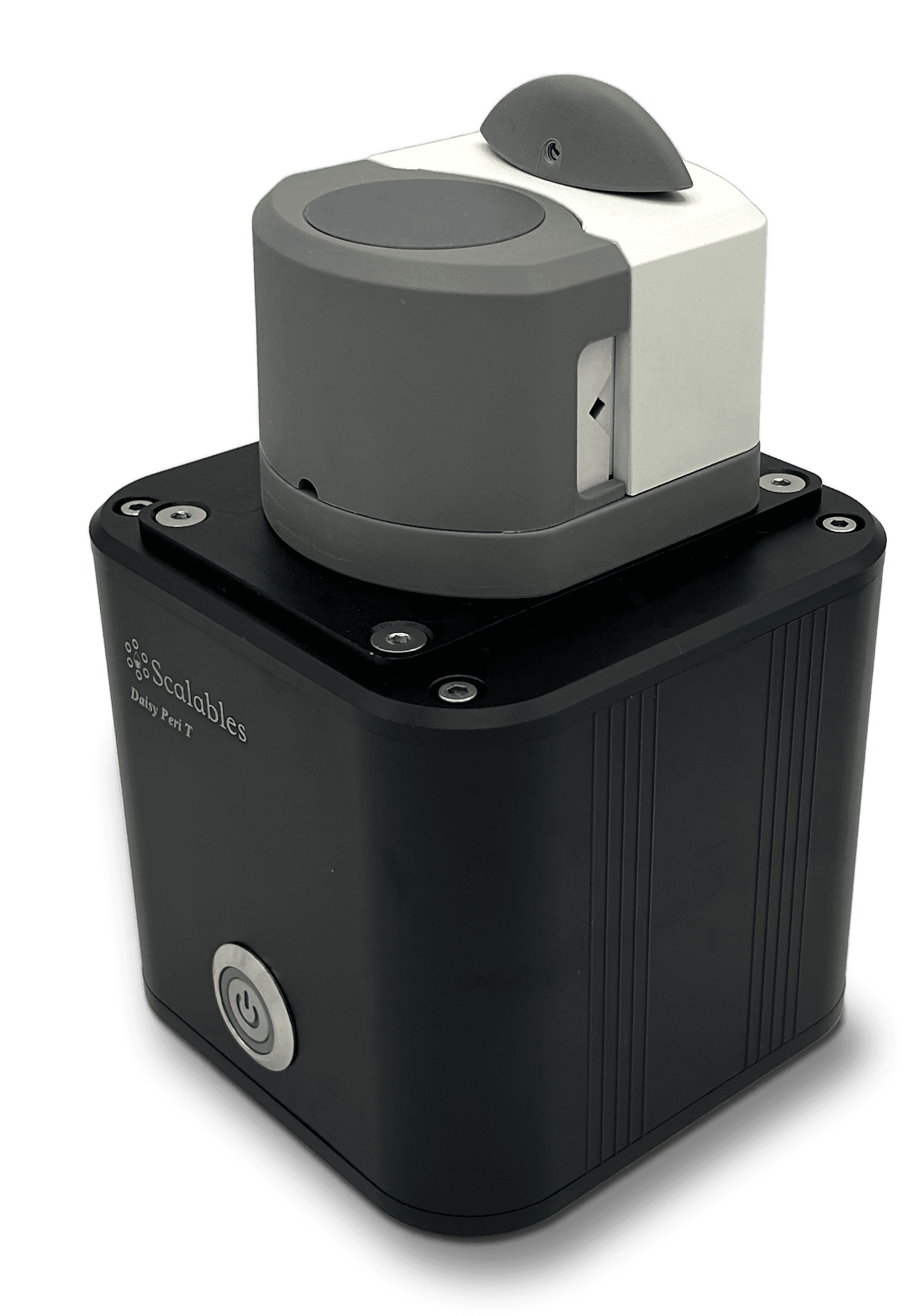
Daisy Peri T
In stock
Request Quote- Satisfaction Guaranteed
- No Hassle Refunds
- Secure Payments
EU consumers: you have a legal guarantee of at least 2 years. Learn more
SKU: DPT-100-3R
Category: Pumps
Downloads
Description
The Daisy Peri T is a versatile and efficient peristaltic pump designed to be a reliable workhorse for a wide range of laboratory and process applications. The pump head can be opened and closed with a single hand. Plain tubing is secured using adjustable grabbers on either side of the head, eliminating the need for anchors or specialized hardware.
With the option to choose between 3 or 6 rollers, the pump provides reliable and consistent fluid transfer for low to moderate flow rates (up to several hundred ml/min).
This module is ideal for everyday lab operations such as filling media containers, transferring reagents, or running cell perfusion experiments. It can function as a dosing pump with quick calibration or as a recirculation pump in a continuous closed process.
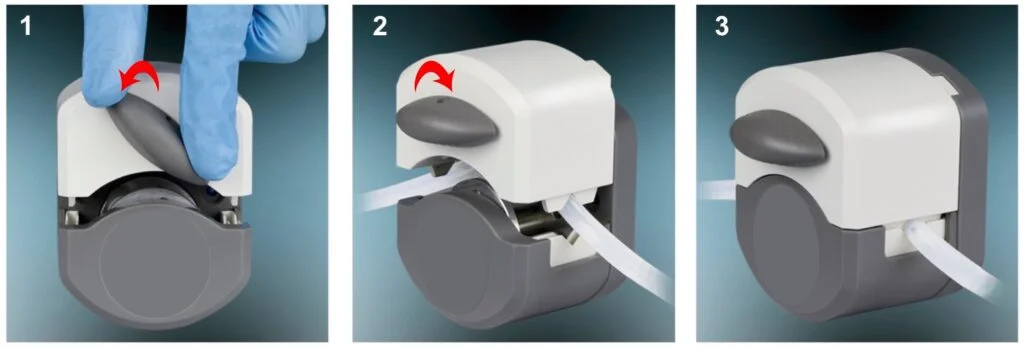
New tubing installation is straightforward. Turn the knob on the upper pump head block counterclockwise 180° to open it, place the tubing over the rollers and through the end grippers, then turn the knob clockwise 180° to close. No tube stoppers or additional hardware are required.
Below is a table summarizing the nominal flow rates expected from the Daisy Peri T pump with different tubing sizes:
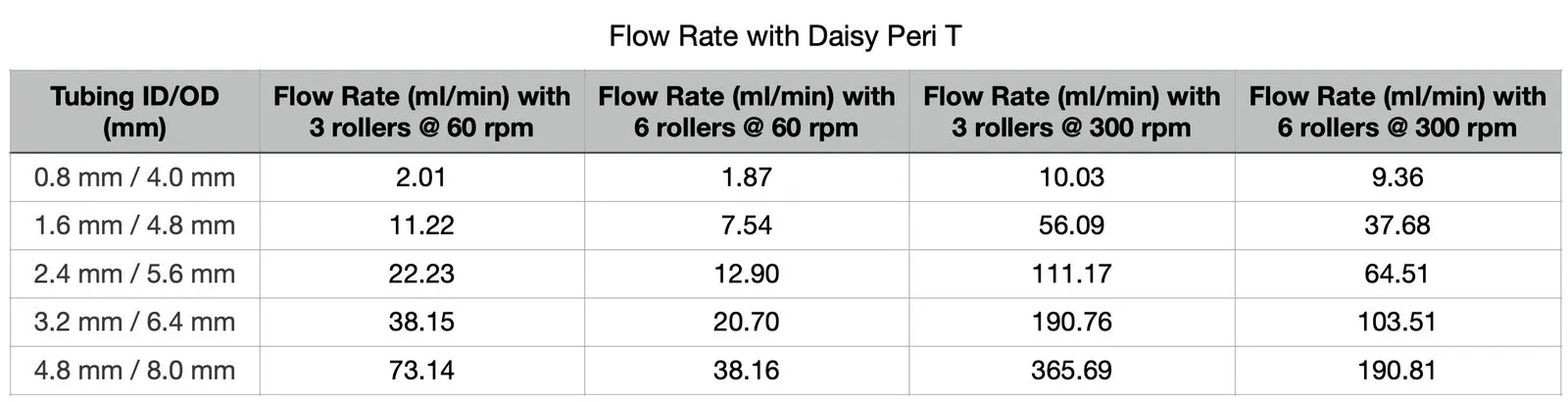
These flow rates assume negligible back pressure. If there is significant flow restriction or pressure drop in the system, it is recommended to perform a custom calibration.
The Daisy Peri T pump is designed for long-lasting performance, minimizing the need for frequent maintenance or replacement.
| Weight | 0.9 kg |
|---|---|
| Dimensions | 100 × 100 × 135 mm |
| Color |
Housing: Anodized black
|
| Number of Rollers | 3, 6 |
| Tubing Material |
Use only BPT or silicone tubing |
| Tubing Size Range |
Min OD: 4 mm
Some Recommended Sizes (ID/OD):
|
| Pump Speed |
Up to 300 rpm
|
| Expected Life Cycle | 3000 hours minimum |
| Leak Pressure |
Pump itself does not leak.
|
| Unit Power Input | 24 VDC, 4 A |
| Power Adaptor Input | 110-240 VAC, 50/60 Hz |
| Operating Conditions |
Temperature: 0-40 degrees C
|
Chemical Compatibility
BPT and Silicone Chemical Compatibility Table (adopted from cole-parmer.com)
Maintenance
Peristaltic Pump Tubing: Essential Selection and Maintenance Tips
Peristaltic pumps offer versatile fluid transfer solutions, but their efficiency and longevity depend on proper tubing selection and maintenance. Following best practices ensures optimal performance and durability.
Understanding Wear and Tear
Over time, tubing can degrade due to friction with the pump head’s rotor, often caused by incorrect tubing length. This leads to accelerated wear and potential bursting after extended use. Prompt replacement and preventative measures are essential.
Selecting the Right Tubing Material
Choosing the correct tubing material is critical. Perform chemical compatibility testing to ensure it withstands the fluid and operating conditions. Temperature, pressure, and bore size all influence tubing performance and lifespan.
Installation and Maintenance Best Practices
Ensure tubing is straight and securely clamped during installation. Regularly inspect for signs of wear such as thinning or abrasion. Replace tubing promptly to minimize downtime and maintain efficiency.
Essential Maintenance Tips
Monitor tubing life expectancy based on factors like transparency, gas permeability, and regulatory requirements. Recalibrate systems as needed to maintain flow accuracy. For sensitive applications, consider extractable and leachable studies.
If tubing breaks and causes a leak, immediately clean and dry the pump head and body. Depending on the fluid, use 70% isopropyl alcohol if needed. Ensure all components are clean and free of residue before installing new tubing.
High-quality pharma BPT tubing can last up to 1000 hours with water. Silicone tubing typically lasts 200+ hours. Factors such as back pressure, temperature, and chemical compatibility may reduce lifespan.
Connecting Peristaltic Pump Tubing
Ensure suction and delivery bores match the tubing size. Use larger bore tubing for viscous fluids and keep tubing lengths flexible to reduce impulse losses. Adjust pump speed to balance tube life, flow rate, and accuracy.
Investing in Quality
Use high-quality tubing from reputable suppliers to ensure reliability and reduce failure risk. Prioritize durability and compatibility for long-term performance.
Conclusion
Proper tubing selection and maintenance are key to reliable fluid transfer. By following best practices and monitoring wear, you can extend tubing life, improve efficiency, and reduce downtime.
Command Set
All Daisy Peri pump models (T or P) share the same command set.
Always start your automation scripts by setting up the interface to the Daisy instruments. Assuming your Daisy Peri pump is the first instrument in the first group:
peri_pump = self.my_interface.groups[0].inst[0]The next step is to calibrate the peristaltic pump:
calibration_speed = 60  # ml/min @ 60 rpm
peri_pump.calibrate(calibration_speed)
The run command format is:
peri_pump.run(, , ) Example: pump 6 ml at 100 ml/min (clockwise direction):
peri_pump.run(100.0, 6.0, wait=True)To reverse direction, use a negative target volume:
peri_pump.run(100.0, -6.0, wait=True)Application Example: Continuous Flow Control
This example uses a Daisy Peri T (peristaltic pump) and a Daisy Rotary Valve to run a cell perfusion assay. The pump provides continuous flow, while the valve switches between reagent inputs based on time of day.
from datetime import datetime
import time

g1 = self.my_interface.groups[0]
peri_pump = g1.inst[0]
multi_val = g1.inst[1]

# Home valve (defaults to port 1)
multi_val.home()

# Calibrate pump
calibration_speed = 7.54  # ml/min @ 60 rpm
peri_pump.calibrate(calibration_speed)

# Define schedule
current_time = datetime.now().time()

breakfast_time = current_time.replace(hour=8, minute=0, second=0, microsecond=0)
breakfast_digest_time = current_time.replace(hour=9, minute=30, second=0, microsecond=0)
lunch_time = current_time.replace(hour=12, minute=0, second=0, microsecond=0)
lunch_digest_time = current_time.replace(hour=14, minute=0, second=0, microsecond=0)
dinner_time = current_time.replace(hour=18, minute=0, second=0, microsecond=0)
dinner_digest_time = current_time.replace(hour=20, minute=15, second=0, microsecond=0)

# Start pump (10 ml/min for 10 days)
peri_pump.run(10.0, 10 * 60 * 24 * 10, wait=False)

while True:
    current_time = datetime.now().time()

    if current_time >= breakfast_time:
        multi_val.select_port(3, wait=False)
    if current_time >= breakfast_digest_time:
        multi_val.select_port(1, wait=False)

    if current_time >= lunch_time:
        multi_val.select_port(4, wait=False)
    if current_time >= lunch_digest_time:
        multi_val.select_port(1, wait=False)

    if current_time >= dinner_time:
        multi_val.select_port(5, wait=False)
    if current_time >= dinner_digest_time:
        multi_val.select_port(1, wait=False)

    time.sleep(60)
Daisy Peri T: The versatile, everyday workhorse pump.
Key applications
- Fluid transfer
- Filling and dispensing
- Washing and rinsing
- Continuous flow
Works with other Daisy modules
Pair the Peri T with a Daisy Sol Val or Daisy Rotary Valve to automate multi-channel switching workflows, or with the Daisy Gantry to aliquot stock solutions automatically.
Click or script
Control the Daisy Peri T with a click in the Daisy Controller Software, or drop into the built-in Python window to automate multi-step protocols. You can control:
- Flow rate (ml/min)
- Dispensing volume
- Aspirating volume
Not a coder? The AI Assistant writes the script for you and catches simple mistakes before you run it.
Frequently asked questions
Should I choose the 3-roller or 6-roller Peri T?
Choose the 3-roller for maximum flow (up to 365 ml/min) with more pulsation, or the 6-roller for a smoother, lower-pulsation flow (up to 195 ml/min).
What tubing does the Daisy Peri T use?
Plain PharMed BPT or silicone tubing with an outer diameter between 4 mm and 8 mm. Tubing installs and swaps in seconds, with no anchors or special cartridges. See the PharMed BPT and silicone tubing sets.
When should I use the Peri P instead?
The Peri T is built for routine fluid movement. If you need the most precise and reproducible dosing, the Daisy Peri P is our precision peristaltic pump.
Want to see it in action? Email [email protected] to schedule a live demo.
Related Products

Daisy Peri P is a precision peristaltic pump with 6 stainless steel rollers. It...
Request Quote
Daisy Piston is the pinnacle of accuracy and precision in dispensing and pumping...
Request Quote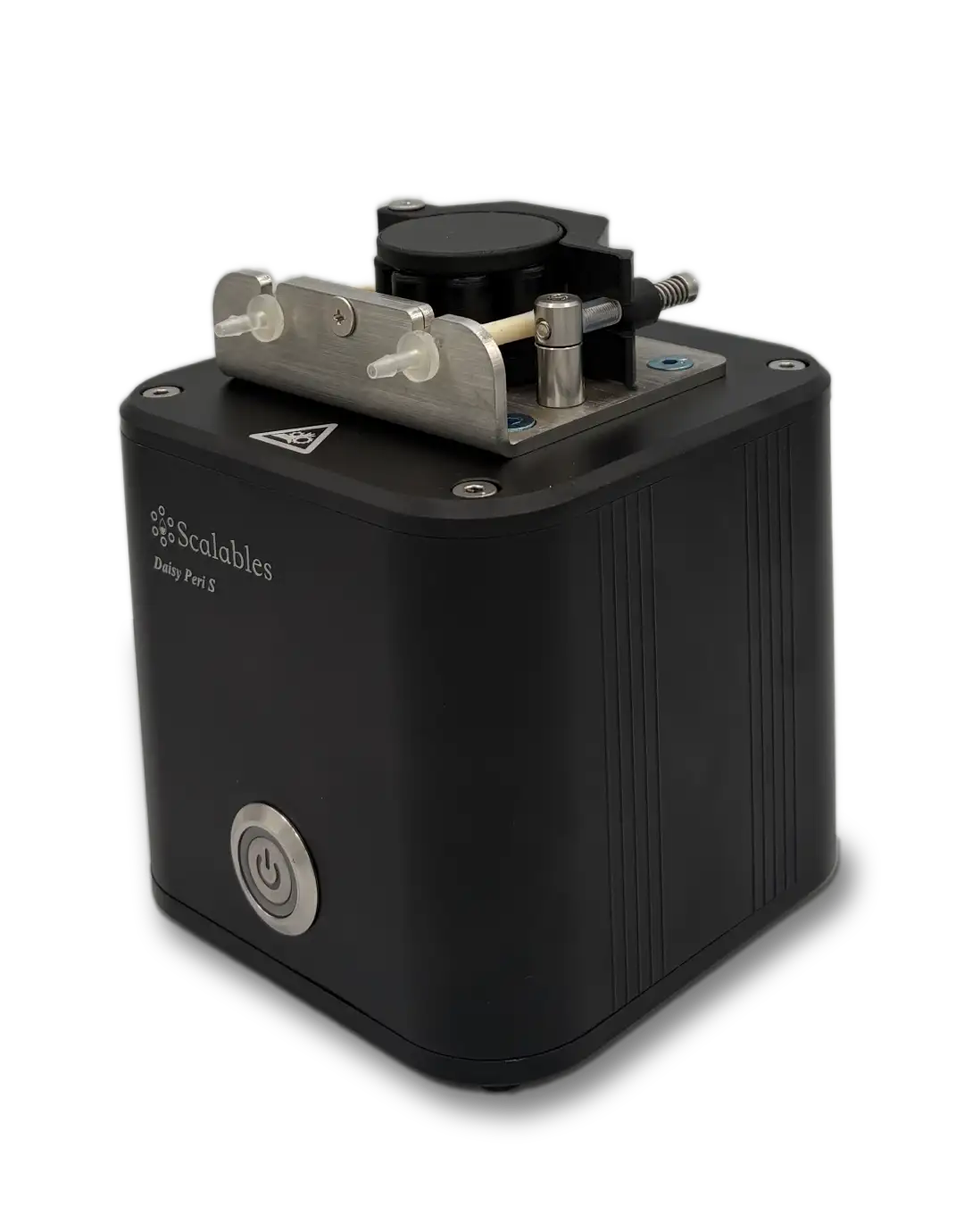
The Daisy Peri S is our compact peristaltic pump and our lead module for bringin...
Request Quote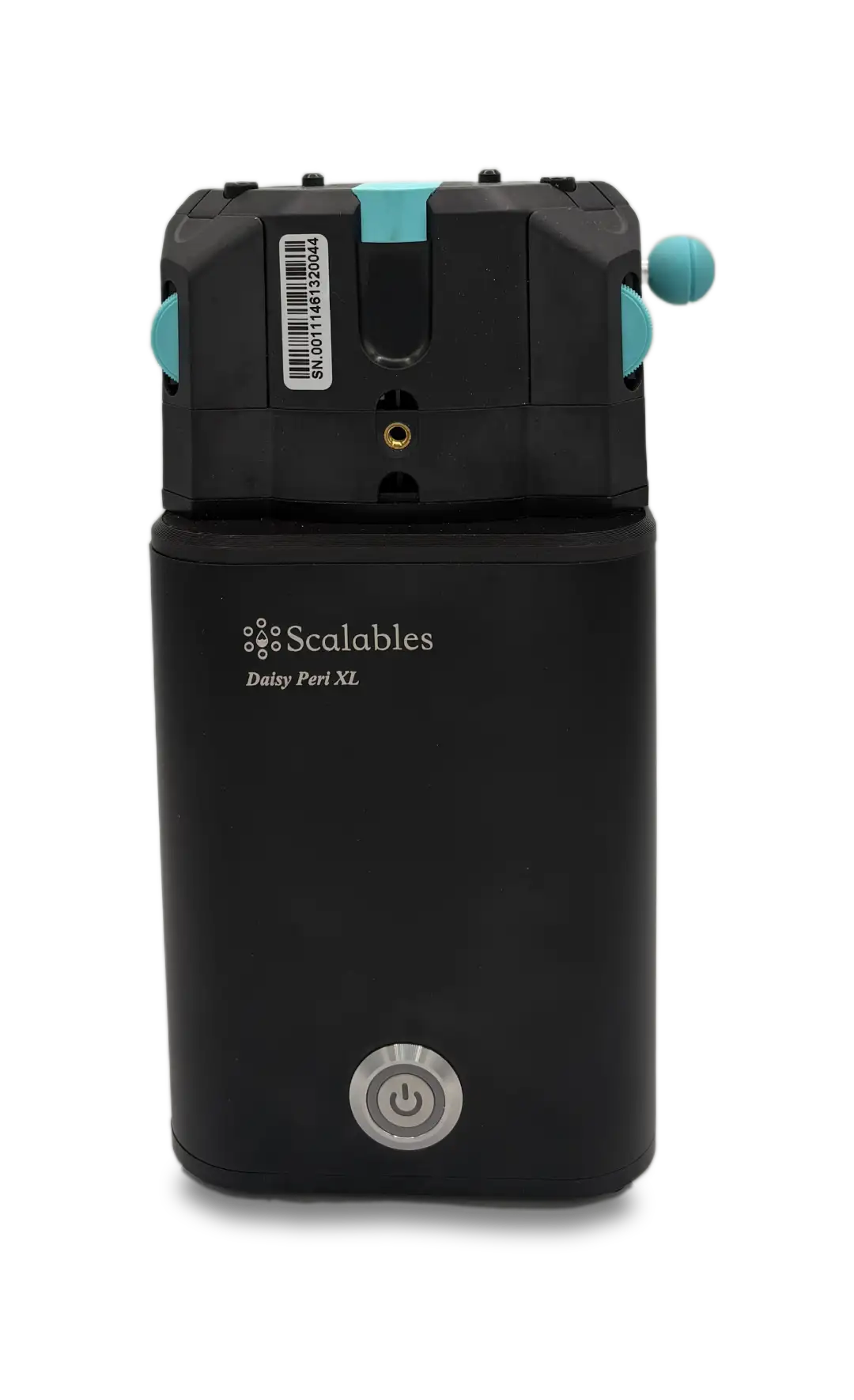
The Daisy Peri XL is our high-flow peristaltic pump. Its EasyPump head moves up...
Request Quote