Summary
Droplet size and rate in a microfluidic chip are set by the flow rates of the two phases. This note shows how Daisy modules supply stable, programmable flows for both, and how to collect the output in separate vials.
Microfluidic droplets: from basic principles to versatile tools
Microfluidic droplet generation is a powerful technology in which one immiscible fluid (for example an aqueous solution) is dispersed in another, often an oil phase, to form highly uniform droplets from picoliters to nanoliters in volume.
These droplets serve as compartmentalized microreactors that can be produced in massive numbers, offering an elegant way to miniaturize and parallelize biological, chemical and diagnostic assays [1]. The small volumes, large surface-area-to-volume ratio and precise flow control possible in microchannels (Figure 1) allow faster reaction rates, reduced reagent use and tight environmental control. This combination has been integral to lab-on-a-chip systems used in drug discovery, materials synthesis and life sciences research [2].
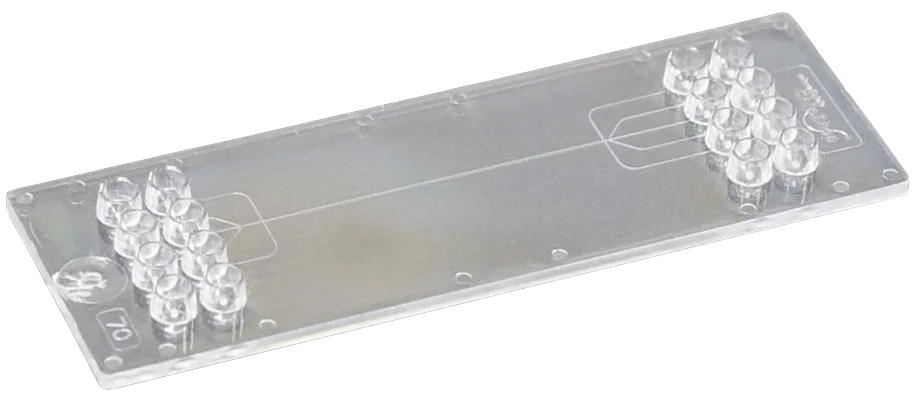
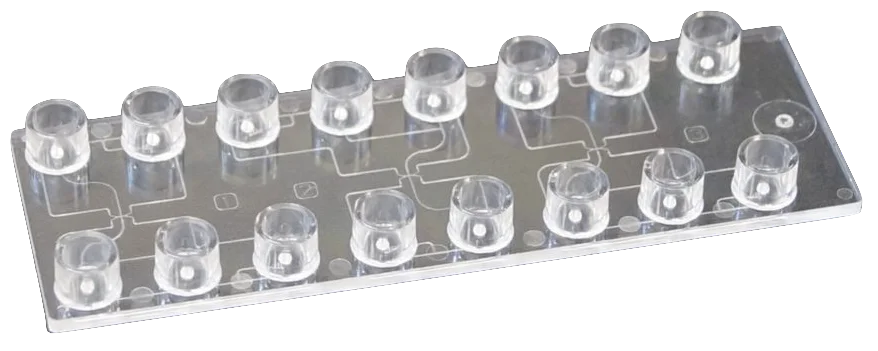
In broad terms, microfluidic droplet generators fall into two main categories.
Passive generation
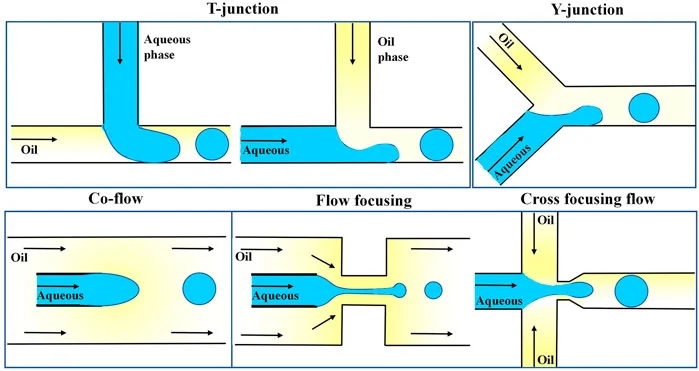
No external energy is added beyond the pressure- or flow-driven forces that move fluids through the channels (Figure 2). The relative flow rates of the two immiscible fluids control the droplet size, relying on phenomena such as capillary shear, channel geometry and fluidic instabilities to break off droplets. Examples include:
- T-junction and Y-junction cross-flow geometries
- Co-flow geometries
- Flow-focusing devices
- Step emulsification and membrane emulsification
Active generation
An external actuation (electric, magnetic, acoustic or mechanical valves) modulates droplet production in real time (Figure 3). This additional energy can provide:
- More independent control over droplet volume and frequency
- On-demand droplets with precise timing
- Faster responses to changing experimental conditions
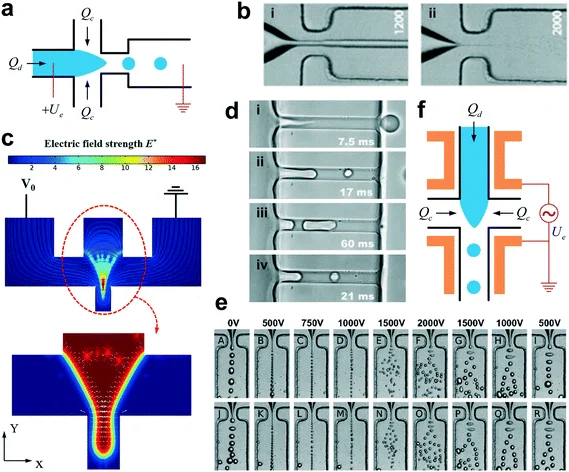
Whether passive or active, these devices typically operate in laminar flow regimes (low Reynolds numbers), so droplet pinch-off is dominated by the interplay of viscous shear forces, interfacial tension, channel confinement and, in some designs, external fields such as electric or acoustic forces [2]. By tuning these factors carefully, highly monodisperse droplets (coefficient of variation typically below a few percent) can be formed at rates of hundreds to thousands of droplets per second, or more.
We focus on passively generated droplets. The instrumentation discussion applies equally to other forms of droplet generation. Uniform droplets depend on uniform flow, since pulsation or drift in either phase shows up directly as variation in droplet size.
Relevance for single-cell analysis and beyond
A major driver of droplet microfluidics is the demand for single-cell research. Single cells show intrinsic heterogeneity: even genetically identical cells can differ significantly in gene expression, metabolism or drug response [1][4]. Traditional methods average signals over millions of cells, masking these differences. Droplet-based microfluidics changes the paradigm by encapsulating individual cells in discrete droplets, effectively isolating each one as a tiny microreactor. This approach offers:
- High-throughput single-cell assays. By running thousands to millions of droplets in parallel, each containing one cell, researchers can rapidly measure how cells respond to different reagents, test drug sensitivities or perform sequencing.
- Quantitative genetics and proteomics. Microfluidic droplets have enabled droplet-based PCR (dPCR) and digital assays for nucleic acids, giving absolute quantification of DNA or RNA from single cells with minimal reagent consumption.
- Single-cell culturing and screening. Some droplet systems allow extended cell culture (for example water-in-oil droplets with specialized surfactants), enabling selection or screening of target phenotypes such as antibody production or metabolic output [1].
Droplet platforms can also handle sensitive cell lines, such as primary immune cells or rare tumor cells, by protecting them from cross-contamination and turbulent shear. Properly formulated droplets with suitable surfactants remain stable, compartmentalizing each cell or cell cluster for experiments that range from minutes to days.
Advanced droplet manipulations such as merging, sorting and splitting expand the capabilities further. Researchers can merge droplets containing different reagents or cell populations, sort droplets by fluorescence or other signals, and run multi-step chemical reactions [5]. This level of automation and reconfigurability is a hallmark of modern droplet microfluidic platforms.
Beyond studying populations of single cells, the technology applies to synthetic biology. Genetic circuits and combinatorial designs can be tested rapidly when each droplet acts as a tiny bioreactor, and libraries of enzymes or organisms can be compartmentalized for massively parallel selection and screening. Droplet generators also enable compartmentalized chemistry, running thousands of miniaturized reactions in parallel to cut reagent use and speed up discovery.
Instrumentation choices
Because droplet size and generation frequency are controlled directly by relative flow rates and channel geometry, precise fluid handling is essential. Researchers commonly choose among three kinds of instrument: displacement pumps (most often syringe pumps), pressure-based controllers and peristaltic pumps.
Syringe pumps
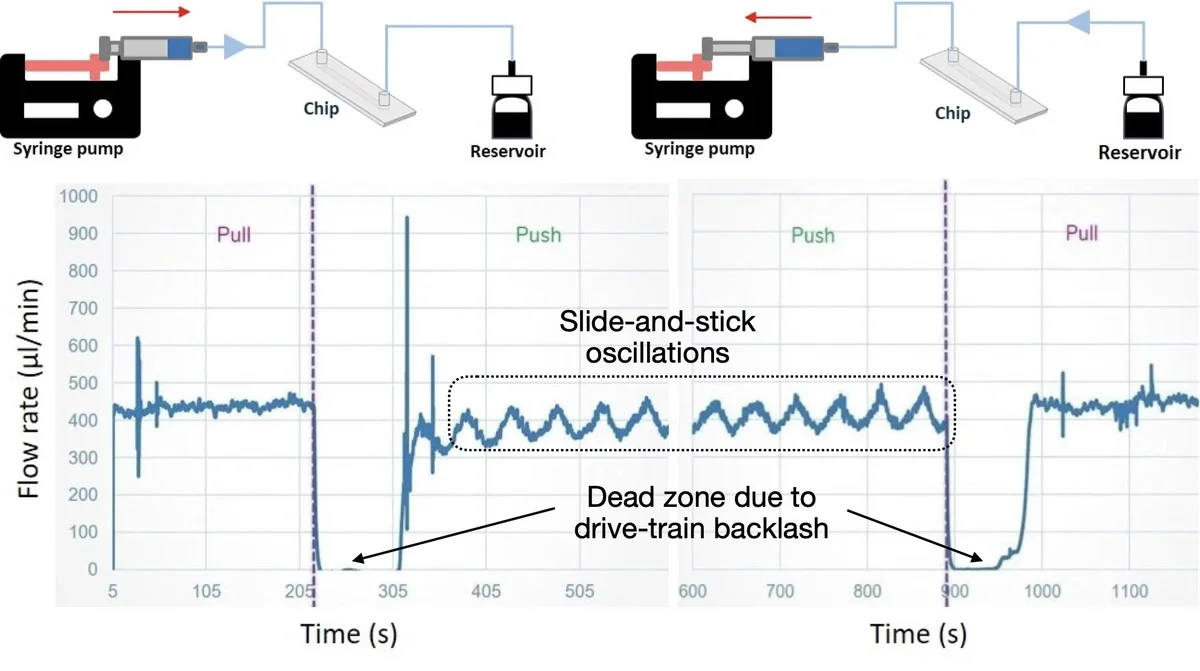
Low cost and simple. Dead zones and stick-slip at low flow rates can add noise.
Pressure controllers
Fast and stable with flow feedback, but they need a regulated gas supply and add hardware and cost.
Peristaltic pumps
Gentle on sensitive samples and easy for long runs. Rolling motion adds pulsation that dampers can reduce.
Syringe pumps
Traditional setups use syringe pumps to drive fluid into a microfluidic chip. Syringe pumps are relatively cheap and simple, though they can struggle to keep very low flow rates steady, or to change flow rapidly, and both matter for droplet uniformity.
Most syringe pumps have no backlash compensation in the drive system, which leaves a dead zone in the stroke after each direction reversal (Figure 4). At low flow rates, periodic stiction of the plunger as it rubs along the inside of the barrel causes the slide-stick phenomenon, which gives jerky movement and noisy delivery. Discrete plunger movements from the finite step size of the stepper motor are a secondary effect that micro-stepping and a suitably small syringe volume can reduce.
Daisy Piston, described below, is also a displacement pump, but it is built to remove the seal friction behind the slide-stick problem.
Pressure-based controllers
Pressure-based controllers respond faster and achieve stable flows, but they are a larger investment and typically need a pressurized air or nitrogen source. Turnkey droplet platforms are larger still and often lack versatility beyond droplet applications.
Without flow-rate feedback, pressure-based systems are highly sensitive to dynamic conditions in the channel, such as start-up oscillations and partial clogging by impurities. Velocity feedback lets them respond quickly to changing flow demands and to changes in channel conditions, giving high stability for demanding droplet generation tasks. On the other hand, the setup needs a stable pressure source, and the supporting hardware upstream of the controller can be bulky.
Peristaltic pumps
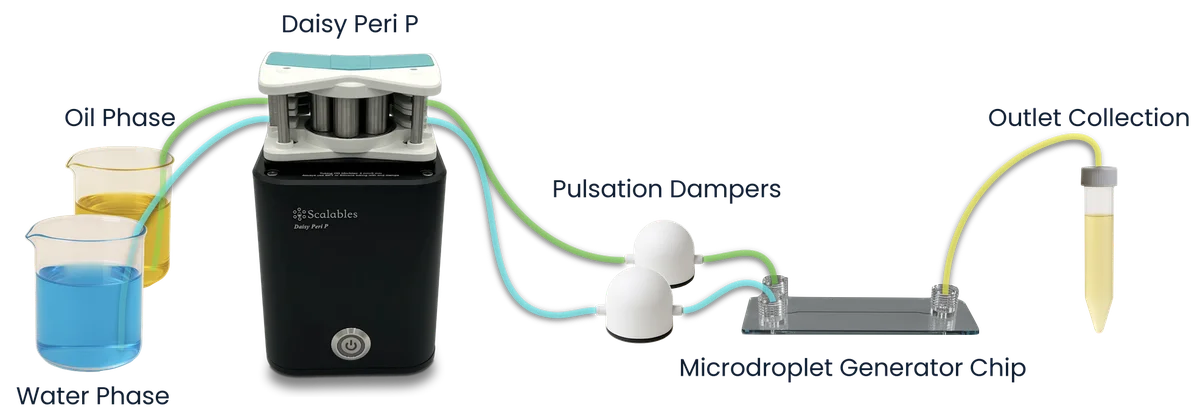
Peristaltic pumps compress and release flexible tubing with rotating rollers, creating a pumping action that drives fluid forward. Because the fluid stays in the tubing and never touches moving mechanical parts, the system is well suited to sterile or shear-sensitive solutions. Peristaltic pumps are typically simpler to operate in long-duration flow scenarios, but their rolling motion causes moderate pulsation in the flow. Users often add flow dampeners or use a two-channel pump head with phase-offset rollers to reduce flow instability when uniform droplets are needed.
In droplet generation, peristaltic pumps are ideal for applications that need continuous, moderate flow control rather than sub-microliter accuracy. They deliver consistent fluid, but the pulsatile profile can cause slight variation in droplet size and frequency unless carefully managed. They remain an accessible, low-cost and robust choice for many droplet experiments, particularly where ultra-low flow rates are not critical and cell- or protein-friendly fluid handling is essential.
Daisy instruments for droplet generation
Daisy Piston: exceptionally steady flow
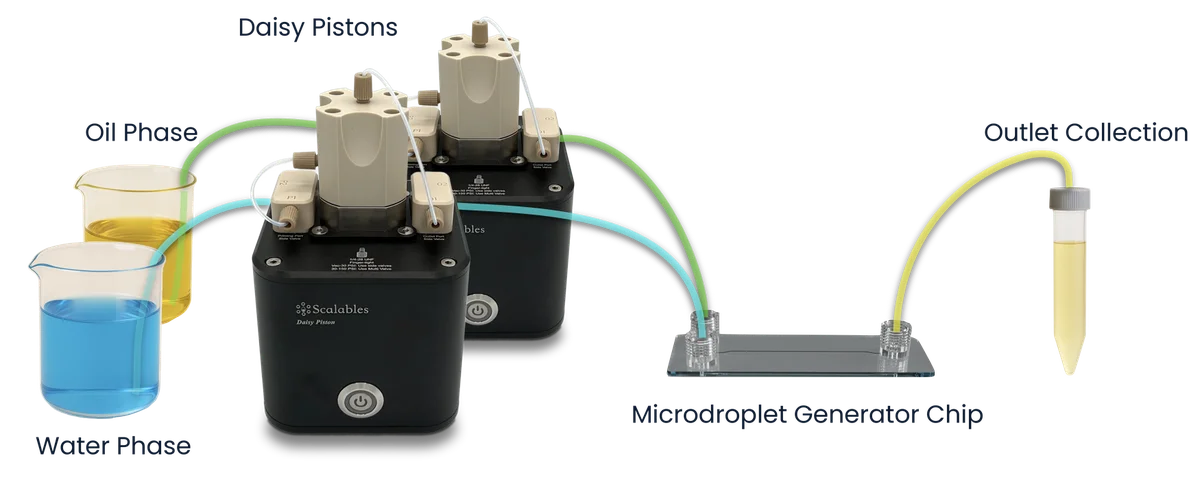
Daisy Piston is a displacement pump built for accurate, precise and steady flow. It moves a cylindrical PEEK shaft within the pump head, much like a syringe pump, but unlike a syringe pump it does not use an elastic sealing material at the top of the piston. That removes a major source of friction, so wear is dramatically lower. It is self-priming and switches easily between aspiration and dispensing, and it is rated for up to 10 million dispensing cycles with DI water (5 million with aggressive fluids), with 0.5% accuracy and under 0.03% CV at full-volume dispensing.
Like a syringe pump, it delivers a fixed stroke volume and refills between strokes, in a few seconds. Daisy Piston comes in 100 µL, 1000 µL and 5000 µL heads, and the 100 µL head suits droplet generation, giving very uniform flow at low rates. In Figure 6, two Daisy Piston pumps control the water and oil phases independently.
Because Daisy Piston is a displacement pump, each stroke ends with a refill. A 100 µL head dispensing at 10 µL/min empties in about 10 minutes, then refills in seconds. Flow pauses briefly during each refill, which the example script handles with a repeating aspirate and dispense cycle. The valve resets to waste at the start of each dispense, so droplets generated during re-stabilization after refill are also excluded from collection.
Daisy Peri P: continuous, moderate flow
For continuous flow where gentle handling matters, Daisy Peri P is a precision peristaltic pump. With flow-dampening solutions it mitigates much of the pulsation usually associated with peristaltic pumping, keeping the gentle, shear-minimized operation of a peristaltic setup. That suits sensitive assays that need controlled, near-constant flow, such as continuous perfusion and droplet-based single-cell studies. Figure 5 shows a simple configuration with a Daisy Peri P and a pair of pulsation dampers driving a droplet generator. For continuous flows of roughly 10 to 1000 µL/min it delivers affordable performance beyond typical peristaltic pumps.
Modular automation with Rotary Valve and Sol Val
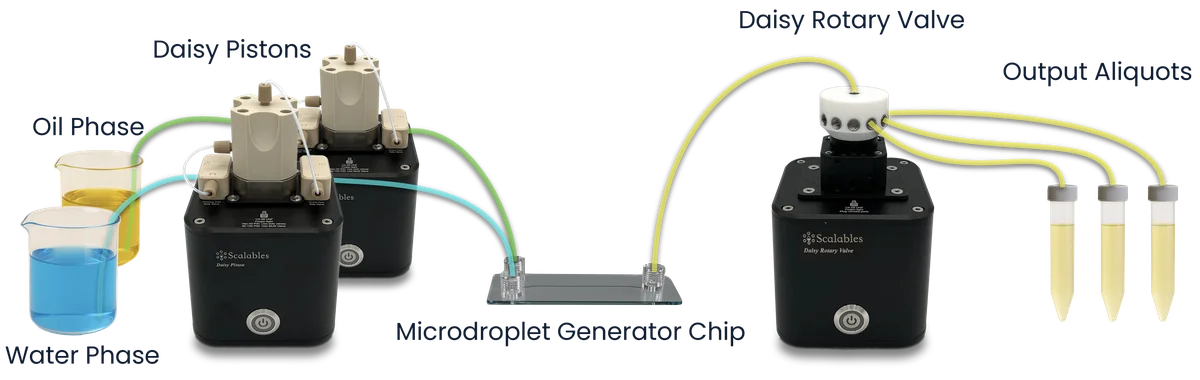
A major strength of the Daisy platform is its modular architecture, so multiple fluid-handling modules integrate easily. For assays with multiple reagents or steps, pairing Daisy Piston (or Peri P) with Daisy Sol Val (solenoid manifold) or Daisy Rotary Valve (12-port rotary selector, zero dead volume) adds flexibility. Input streams can be switched automatically, or output directed to different collection vials, all under synchronized software control (Figure 7). This suits multi-phase droplet generation, automated dilutions and consecutive reagent additions within one workflow. Housings and fluid paths use inert materials such as PEEK and PTFE; making the modules suitable for a wide range of solvents, reagents and biological samples.
Example setups
Figures 5 to 7 show three configurations. All drive the same kind of droplet chip; only the pumping and routing change.
What each configuration uses
| Configuration | Daisy modules | Other components | Best for |
|---|---|---|---|
| Figure 5 | 1 Daisy Peri P | 2 pulsation dampers, droplet chip | Continuous, moderate flow at an affordable cost |
| Figure 6 | 2 Daisy Piston pumps | Droplet chip | Independent, very steady control of each phase |
| Figure 7 | 2 Daisy Piston pumps, Daisy Rotary Valve | Droplet chip, collection vials | Back-to-back conditions collected separately |
Script
This script uses two Daisy Piston pumps and one Rotary Valve, as in Figure 7. Each pump aspirates a fixed volume of its phase, then dispenses at its target flow rate toward the chip. Before each dispense, the Rotary Valve switches to waste so the initial flow, before droplets stabilize, is not collected. Conventional syringe pumps can take 30–120 seconds to stabilize because of seal friction and drive backlash. Daisy Piston eliminates those sources, so the remaining settling time depends mainly on the compliance of your tubing and chip. With rigid tubing and a small chip the settling is typically a few seconds; a PDMS chip or soft tubing sections may need longer. Set the waste duration by watching droplet size under a microscope until it stops drifting. The script then switches to the collection vial and waits for the pumps to finish before aspirating again.
Oil phase formulation: The oil phase requires a surfactant to stabilize droplets and prevent coalescence after formation. The right choice depends on your oil type, your chip material and its surface wettability, the biological or chemical compatibility requirements of your assay, and whether droplets need to remain stable for seconds or for extended culture periods. Consult your chip supplier’s recommended formulation as a starting point, and confirm that the surfactant is compatible with your downstream readout. Without a suitable surfactant, droplets will merge on contact and no stable emulsion will form.
Prime the pumps before running the script. Waste and collection timing depends on the length of the tubing between the chip and the valve.
"""Piston Pumps + Rotary Valve: Droplet Generation Demo
Aspirates water and oil, dispenses both to waste while the droplet stream
stabilizes, then collects each cycle in its own vial on the rotary valve.
Adjust the waste time (time.sleep) to your chip.
"""
import time

g1 = self.my_interface.groups[0]
pump_water   = g1.inst[0]    # Piston, 100 µL head, water phase
pump_oil     = g1.inst[1]    # Piston, 1000 µL head, oil phase
outlet_valve = g1.inst[2]    # Rotary Valve at the chip outlet

WASTE_PORT = 1               # valve port for waste
VIAL_PORTS = [2, 3, 4]       # one collection vial per cycle

print("Homing pumps and valve...")
pump_water.home()
pump_oil.home()
outlet_valve.home(wait=True)

for vial_port in VIAL_PORTS:
    print(f"Cycle for vial on port {vial_port}")

    # Aspirate water: 100 µL at 600 µL/min, oil: 500 µL at 3000 µL/min
    pump_water.aspirate(600.0, 100.0, wait=True)
    pump_oil.aspirate(3000.0, 500.0, wait=True)

    # Dispense water at 10 µL/min and oil at 50 µL/min (about 10 min)
    outlet_valve.select_port(WASTE_PORT, wait=True)
    pump_water.dispense(10.0, 100.0, wait=False)
    pump_oil.dispense(50.0, 500.0, wait=False)
    time.sleep(4)                                    # dispense into waste; adjust duration for your chip
    outlet_valve.select_port(vial_port, wait=True)   # to collection vial
    time.sleep(600)                                  # continue until done (about 10 min)

print("Done.")
This version runs in the Daisy Controller App’s Python window. For standalone Python or notebooks, use the daisylab library.
Key takeaways
- Stable flow, uniform dropletsDroplet size follows flow rate, so smooth, programmable flow from Piston or Peri P gives control from software.
- Automated collectionA Rotary Valve routes the settling period to waste and each condition to its own vial.
- Reconfigurable hardwareThe same modules go on to microplate dispensing, flow injection and other fluid-handling tasks after the experiment.
Questions or want to try this on your chip? Email [email protected] to request a demo or a quote.
References
- Li B, Ma X, Cheng J, Tian T, Guo J, Wang Y and Pang L (2023), Droplets microfluidics platform: a tool for single cell research. Front. Bioeng. Biotechnol. 11:1121870.
- Zhu P. and Wang L. (2017), Passive and active droplet generation with microfluidics: a review. Lab Chip, 17, 34-75.
- microfluidic ChipShop. https://www.microfluidic-chipshop.com/
- De Jonghe J, Kaminski T.S., Morse D.B. et al. (2023), spinDrop: a droplet microfluidic platform to maximise single-cell sequencing information content. Nat Commun 14, 4788.
- Nan L., Mao T. & Shum H.C. (2023), Self-synchronization of reinjected droplets for high-efficiency droplet pairing and merging. Microsyst Nanoeng 9, 24.
- Microfluidics Innovation Center. https://microfluidics-innovation-center.com