Introduction to Microfluidic Droplet Generation and Single-Cell Applications
In this application note, we explore microdroplet generation methods and see how the Daisy platform can make creating an affordable setup a breeze.
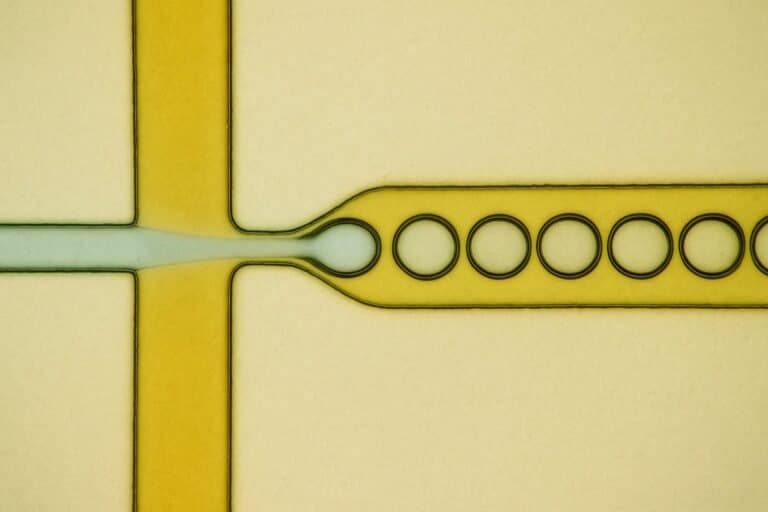
Microfluidic Droplet Generation: An Overview
Microfluidic droplet generation has become a cornerstone technique in modern biomedical research, enabling the creation of highly uniform water-in-oil or oil-in-water emulsions at rates of thousands per second. These picoliter-to-nanoliter-scale droplets serve as miniaturized reaction vessels, making them ideal for high-throughput screening, directed evolution, and digital PCR applications. The ability to encapsulate individual cells, reagents, or biomolecules within discrete compartments has opened entirely new avenues in single-cell genomics and proteomics.
Single-Cell Analysis and Why It Matters
Traditional bulk assays average signals across millions of cells, masking the heterogeneity that drives disease progression, drug resistance, and cellular differentiation. Single-cell analysis addresses this limitation by interrogating each cell individually. Droplet-based microfluidics is particularly well-suited for this task because it compartmentalizes cells into isolated reaction chambers, preventing cross-contamination and enabling massively parallel workflows. Researchers can now profile tens of thousands of individual cells in a single experiment, generating rich datasets that reveal rare cell populations and transient cellular states.
Challenges with Traditional Setups
Despite its promise, setting up a microfluidic droplet generation system has historically been expensive and complex. Commercial platforms often cost tens of thousands of dollars and come with proprietary consumables that further inflate operating budgets. Additionally, many systems are inflexible, tying researchers to specific chip geometries and flow rate ranges. For early-stage labs and academic groups operating on tight budgets, these barriers can be prohibitive.
How Daisy Makes Droplet Generation Accessible
The Daisy platform from Scalables addresses these challenges by offering a modular, affordable approach to microfluidic workflows. By combining precision syringe pumps with configurable flow controllers, researchers can assemble a droplet generation setup tailored to their exact specifications without purchasing an entire monolithic instrument. The platform's AI-assisted protocol builder simplifies flow rate optimization, while universal fittings ensure compatibility with standard microfluidic chips from any vendor. The result is a system that delivers research-grade droplet uniformity at a fraction of the traditional cost, empowering more labs to adopt single-cell techniques.