Science is about to shift into overdrive! Buckle up!
Ever wish you could clone your most skilled lab colleague? AI co-scientists are making that possible.
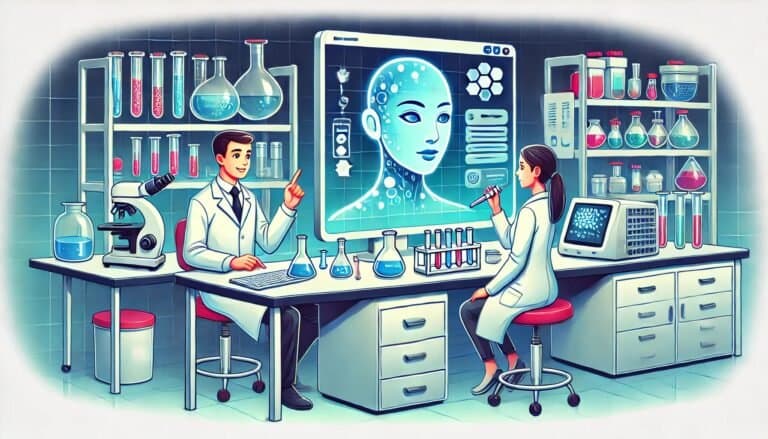
The Rise of AI Co-Scientists
Artificial intelligence is no longer confined to data analysis and image recognition in the laboratory. A new generation of AI systems, often called AI co-scientists, can now actively participate in experimental design, hypothesis generation, and even real-time protocol optimization. These systems leverage large language models trained on vast corpora of scientific literature, combined with reinforcement learning from laboratory outcomes, to suggest experimental strategies that would take human researchers weeks to devise. The result is a fundamental acceleration of the scientific discovery cycle.
From Manual Pipetting to Autonomous Experimentation
The integration of AI co-scientists with physical laboratory automation creates a powerful feedback loop. An AI system can design an experiment, translate it into machine-executable instructions, monitor the results through connected sensors, and iteratively refine the protocol in real time. This closed-loop approach eliminates the traditional bottleneck of manual data interpretation between experimental runs. Early adopters of this paradigm are reporting two- to five-fold improvements in time-to-result for optimization tasks such as protein purification, cell culture media formulation, and chemical synthesis screening.
Modular Hardware Meets Intelligent Software
For AI-driven automation to reach its full potential, the underlying hardware must be flexible, reconfigurable, and programmable through standard interfaces. This is precisely where modular platforms like Daisy excel. Because each module exposes a consistent API, AI co-scientist systems can dynamically reconfigure fluid pathways, adjust flow rates, and coordinate multi-instrument workflows without human intervention. The platform's open command protocol means it can integrate with any AI orchestration layer, from simple Python scripts to sophisticated autonomous experimentation frameworks.
Preparing Your Lab for the AI Era
The transition to AI-augmented research does not require a wholesale lab renovation. Labs can begin by automating their most repetitive workflows with modular instruments and progressively layering AI capabilities as the technology matures. Starting with AI-assisted protocol generation and graduating to fully autonomous experimental cycles allows teams to build confidence and expertise incrementally. The laboratories that invest in flexible, AI-ready infrastructure today will be positioned to capitalize on breakthroughs that are just beginning to emerge from leading research institutions worldwide.