Valves
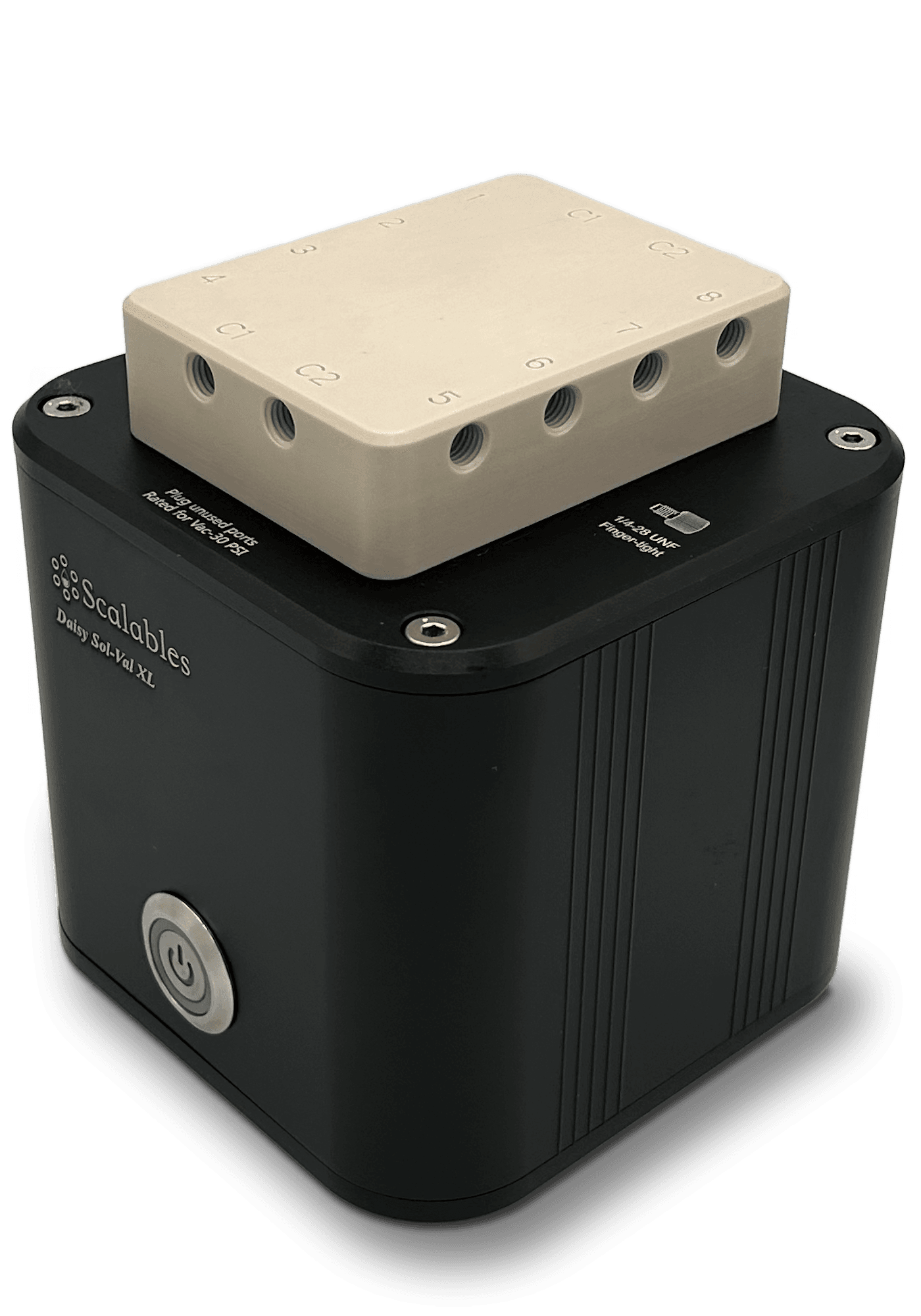
Daisy Sol Val XL
Available on backorder
Free shipping on orders over $2500!
- Satisfaction Guaranteed
- No Hassle Refunds
- Secure Payments
- Pre-order items ship in 8 weeks
EU consumers: you have a legal guarantee of at least 2 years. Learn more
SKU: DSVXL-100
Category: Valves
Description
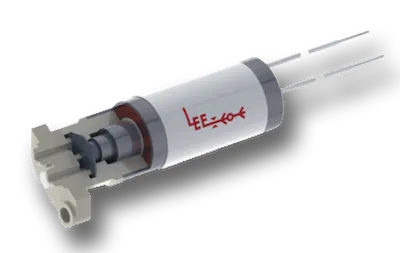 Daisy Sol Val XL is the larger sibling of Daisy Sol Val — it features a bigger manifold with larger solenoid valves to accommodate faster flow rates. Specifically, this instrument uses 8 LFV series, isolation style, 2-way normally closed solenoid valves from Lee Company (Connecticut, USA). The LFV valves contain a diaphragm seal made out of a chemically inert elastomer (EPDM) that isolates and protects the valve’s inner parts from the fluid. Each valve is 100% functionally tested by the factory to ensure optimal and reliable switching performance. These valves are regularly used in medical, biotechnology, and scientific measurement and research instrumentation owing to their reliability and consistent performance.
The LFV series solenoid valves feature zero dead volume and only 21 μl of internal volume that is readily and easily flushable without retention. They can operate at pressures from vacuum to 30 psig. The maximum flow rate through these valves before they can no longer fully close (above 30 psi differential pressure) is 415 ml/min. Therefore, the Daisy Sol Val is recommended for applications with flow speeds typically under 400 ml/min.
The valves can switch in as little as 30 ms, but increasing pressures within the valve body may impact their dynamics. Daisy Sol Val is designed for moderate-speed (e.g., a few Hz) switching. Separate modules for specialized high-speed applications (such as nanoliter dispensing) will be offered in the near future.
The valve heads and the flow manifold itself are precision manufactured out of PEEK, which is highly chemically compatible with a wide variety of aqueous and organic solutions. Check the Chemical Compatibility section for more information on wetted materials (PEEK and EPDM).
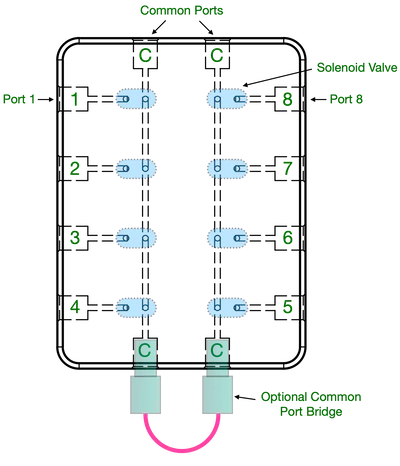 The manifold is designed to house 4 channels along a common port line on either half of the manifold. The common channels can be bridged to yield an 8×1 configuration, or kept separate to yield two 4×1 configurations. Whenever a given valve opens, it is connected to the common channel, allowing fluid to flow between the side port and the common port(s). In one typical application, the user would select from multiple input samples and direct that stream through the common port into a target vessel or flow channel via a downstream pump. The reverse is also possible, with the target stream being directed to different output locations via an upstream pump. Multiple Daisy Sol Val modules can be chained to create custom flow networks as needed.
Plug all unused ports with our specialized port plugs.
For applications requiring a different topology — such as 2-way or 3-way isolated ports without a common channel — we can offer alternative and custom manifold configurations with the Daisy Sol Val. Simply reach out to us with your custom request before ordering.
Additional Information
| Weight | 0.83 kg |
|---|---|
| Dimensions | 100 × 100 × 115 mm |
| Valve Volume |
Dead Volume: 0 ul Internal Volume: 21 ul |
| Expected Life Cycle | DI Water: 10 M cycles (minimum) |
| Operating Pressures | Vac – 30 psi |
| Over Pressure Range |
30 psi differential Valve Proof Pressure: 2× Normal Rated Pressure Valve Burst Pressure: 3× Normal Rated Pressure |
| Wetted Materials |
Valve Head: PEEK Valve Diaphragm: EPDM Manifold: PEEK |
| Port Configuration |
1/4-28 Standard Fitting Flat bottom |
| Manifold Configuration |
2 × 4×1 (4 Branches on 1 Common line; two each) 1 × 8×1 (8 Branches on 1 Common line) |
| Unit Power Input | 24 VDC, 4 A |
| Power Adapter Input | 110-240 VAC, 50/60 Hz |
| Adapter Safety Certifications | FCC, CE, UL |
| Color |
Housing: Anodized black Manifold: Tan (PEEK) |
| Operating Conditions | Temperature: -1 to 49 °C (30-120 °F) |
| Storage Conditions |
Temperature: -40 to 80 °C (-40 to 175 °F) Relative Humidity: 85% (max), non-condensing |
Chemical Compatibility
Polyether ether ketone (PEEK) Chemical Compatibility Reference Table (adopted from www.calpaclab.com)
Ethylene Propylene (EPDM) Chemical Compatibility Reference Table (from www.ipexna.com)
Customizations
If you need a different valve manifold configuration for your specialized application, please contact us with your request.
Maintenance
We recommend cleaning the Daisy Sol Val XL by flushing it with plenty of DI water after each use. The goal is to wash away any residual solutions containing salt, as salt crystals remaining behind after aqueous buffers dry out will otherwise wear out the internal moving parts over time.
If organic materials were used with the Daisy Sol Val XL, flushing it with ethanol first (followed by DI water) is a good idea.
After cleaning flushes, either DI water or air may be left inside the manifold for short-term storage.
Command Set
Note: Daisy Sol Val and Sol Val XL instruments use the same command set. You can use these instruments interchangeably. Sol Val XL is appropriate for higher flow rate applications, as described in the More Information tab.
Always start your automation scripts by setting up the interface to the Daisy instruments. Assuming your Daisy Sol Val XL (solenoid valve manifold) is the first instrument in the first group:
sol_val_xl = self.my_interface.groups[0].inst[0]The activation command format is:
sol_val_xl.turn_on_valves({set of valve numbers})The set of valves includes numbers from 1 through 8. For example, turning on valves 3, 5, and 8:
sol_val_xl.turn_on_valves({3, 5, 8})If a different set of valves is specified, any valve that was previously on turns off if it is not included in the new set. For instance:
sol_val_xl.turn_on_valves({2, 5, 7})This command turns off valves 3 and 8, turns on 2 and 7, and keeps 5 on.
All valves are turned off with:
sol_val_xl.turn_off_valves()Application Example: Automatic Reagent Mixing
The script below uses two Daisy Sol Vals and a Daisy Piston Pump to set up a reagent mixing station. The piston pump is placed between the Sol Vals, which select the source reagents and destination vials, respectively.
g1 = self.my_interface.groups[0]

sol_val_xl_1 = g1.inst[0]    # upstream Sol Val XL (selecting inputs)
piston_pump  = g1.inst[1]    # Daisy Pump
sol_val_xl_2 = g1.inst[2]    # downstream Sol Val XL (selecting outputs)

# Start by homing the piston pump
piston_pump.home()
piston_volume = 5000  # µL (5 mL pump)

# Reagent mixing configuration
mixing_volumes = [300, 500, 100, 600]  # µL per reagent
priming_volume  = 300                   # µL
output_vials    = 6

for ii in range(4):  # 4 input reagent vials
    sol_val_xl_1.turn_on_valves({ii + 1})

    # Aspirate required amount into pump
    piston_pump.run(60000, mixing_volumes[ii] * output_vials + priming_volume, 0, wait=True)

    # Prime flow line to waste
    sol_val_xl_2.turn_on_valves({8})  # 8th output port is waste
    piston_pump.run(60000, priming_volume, 1, wait=True)

    # Dispense to output vials
    for jj in range(output_vials):
        sol_val_xl_2.turn_on_valves({jj + 1})
        piston_pump.run(60000, mixing_volumes[ii], 1, wait=True)
Daisy Sol Val XL: Switch reagents fast with two configurations.
Key applications
- High-flow reagent switching
- Multi-input routing
- Scale-up workflows
Works with other Daisy modules
Pair the Sol Val XL with the Daisy Peri T (or the Peri P for precision) to control liquid movement in ELISA, wash, or media delivery workflows. Add the Daisy Gantry and a Daisy pump to build a compact liquid handler.
Click or script
Control the Daisy Sol Val XL with a click in the Daisy Controller Software, or drop into the built-in Python window to automate multi-step protocols. You can control:
- Open a single valve
- Open several valves at once
- Close several valves at once
Not a coder? The AI Assistant writes the script for you and catches simple mistakes before you run it.
Frequently asked questions
What is the difference between the Sol Val XL and the Sol Val?
The XL handles much higher flow (up to 400 ml/min versus 100 ml/min) and switches in 30 ms. It can also run as two separate 4 x 1 manifolds. The Daisy Sol Val is a single 8 x 1 manifold with a smaller 9 µl internal volume and 20 ms switching.
Why use the two 4 x 1 configuration?
It lets you keep samples and wash buffers on separate manifold paths, so they never share a common port.
How much liquid stays inside the valve?
The entire internal volume, including both common ports, is 21 µl, for rapid flushing, minimal carryover, and minimal waste.
Want to see it in action? Email [email protected] to schedule a live demo.
Related Products
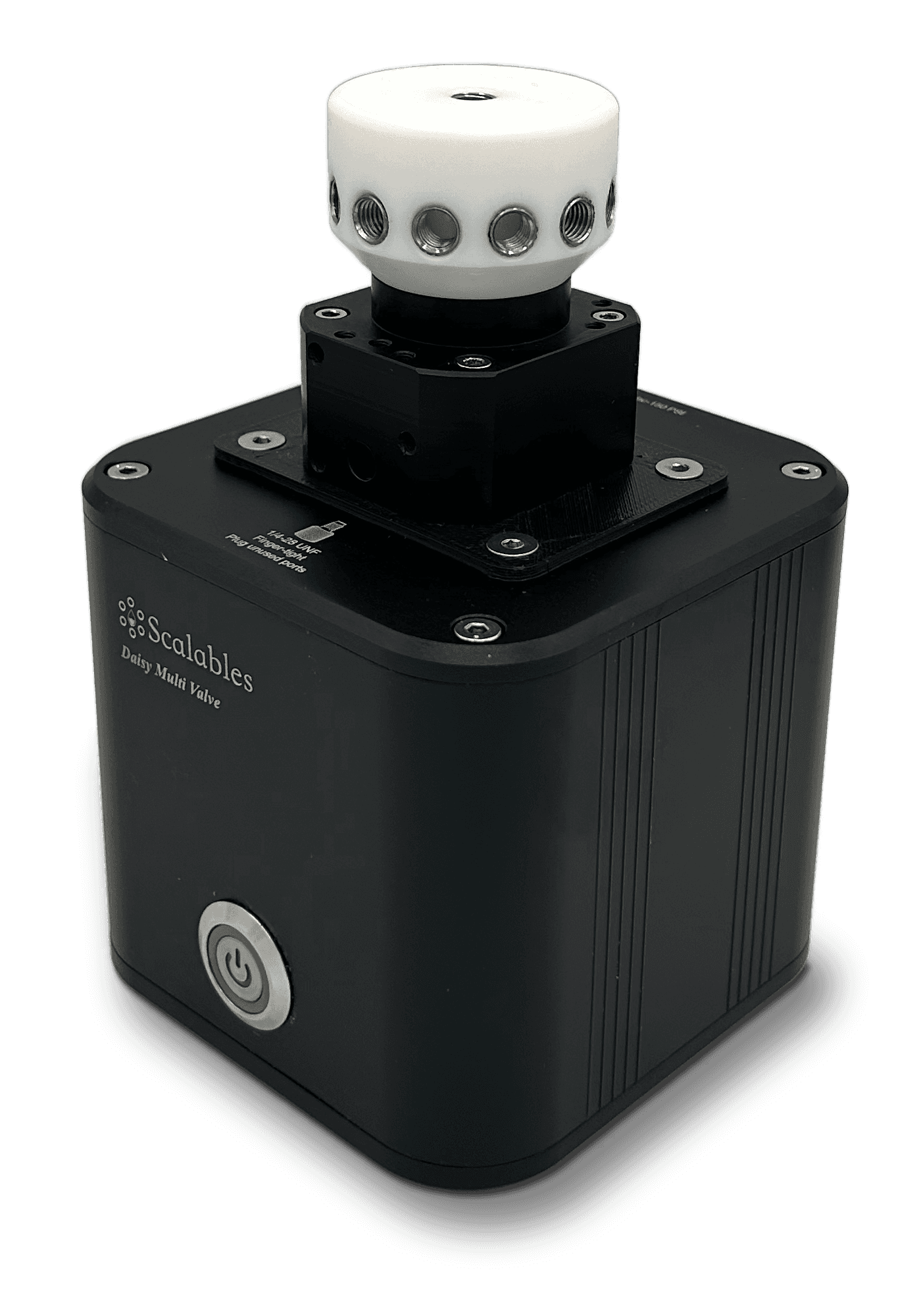
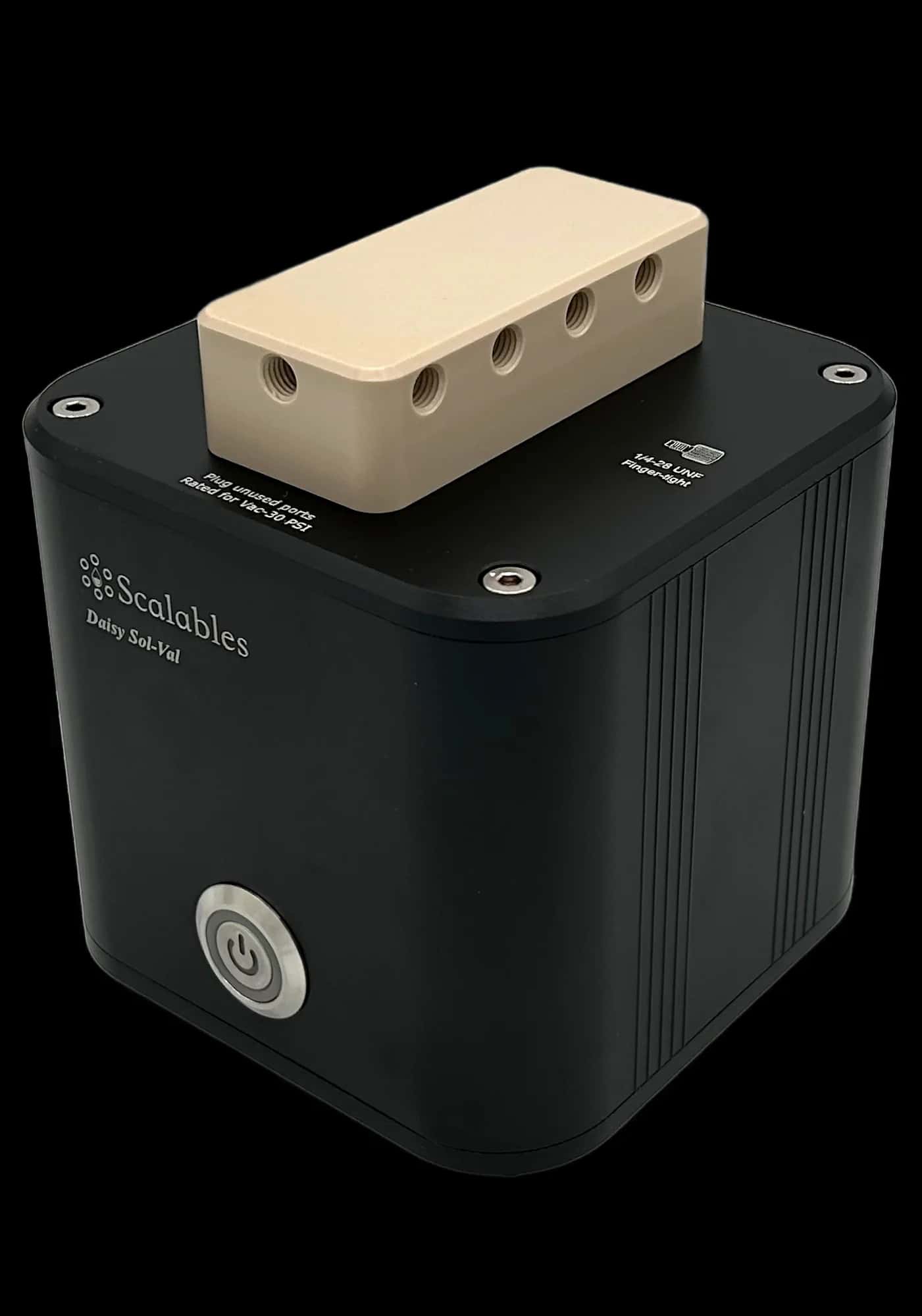
Daisy Sol Val features a PEEK flow manifold comprised of 8 separate channels con...
Select options